Processing Centres
The four production units—Bangalapadigai, Pillur, Pudukad, and Banagudi—stand as the foundational pillars of Aadhimalai Pazhangudiyinar Producer Company Ltd. Incubated by Keystone Foundation and formally registered in 2013, Aadhimalai is entirely owned by tribal shareholders, combining sustainable harvesting, traditional ecological knowledge, and fair trade practices into a model that is both community-driven and environmentally conscious.


Bangalapadigai
Back in 2003, Keystone Foundation began exploring what could naturally flourish around Bangalapadigai, a tribal hamlet roughly 34 km east of Kotagiri, perched at around 1,000 m MSL. Locals such as members of the Irula tribe, relied on forest grafts like shikakai, amla, soap berries, honey, and traditional millet. With Keystone’s support, the village head and community self-help group Bangalapadi Nila Vala Membaattu Kulu took the leap from cautious interest to production.
The name “Bangalapadigai” comes from the grand bungalow of that time, the village’s largest house, which became the first makeshift processing hub before they moved into the community hall. Then, in 2006, they built a dedicated centre where they still operate.
Early products included amla honey, silk, coffee, and pepper. Today, they also gin silk cotton, process honey, pack millets, and more. In 2024, a solar panel installation marked their commitment to reducing carbon footprint in alignment withthe Sustainable Development Goals (SDGs).Now, a team of five women, led by eldest in-charge Mrs Chithra, a shareholder and landholder, runs the unit, combining traditional tribal farming knowledge with modern ecological practices.
Pillur
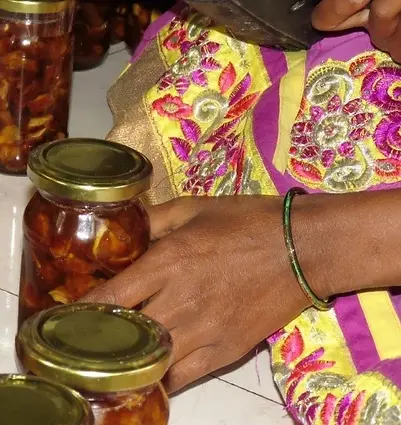
In 2003, eight women began pickle-making inside a millet farmer’s home in Keezh Pillur. After a year, as transport obstacles became clear, their SHG, Pillur Nadu Magalir Kulu, shifted operations to an “EB quarters” space. By 2007, they’d established a proper production centre in the ecologically sensitive Pillur valley.
This area, rich in NTFP and shadowed by a hydel dam, still relies on rainfed agriculture, and elephants often venture into this rain-shadow zone. Traditional farmers grew millets, pulses, and grains and have recently introduced banana plantations. The team has begun experimenting with banana-fiber baskets and mats, leveraging local growth and traditional craft.
Today, it’s operated by four tribal women, led by Kaaliammal, who is also a shareholder. The team procures grains for nearby Mettupalayam market, bringing structure where none existed.


Pudukad
Around 2005–06, Kurumba tribal woman Susheela took initiative on the Coonoor slopes to establish a centre that would focus on honey varieties, balms, soaps, and pickles. They began in a rented tribal house, slowly evolving into a full-fledged production centre as local women embraced value addition.
Despite many challenges, the group persevered, and was soon recognized by the local government as a successful tribal women’s enterprise in Nilgiris district. Today, five women, under the leadership of Mrs Sumithra, continue to produce rich, non-timber forest produce–based goods in this hub.
Banagudi
The youngest of the four, Banagudi, was set up in 2020 amid the COVID crisis. To create new livelihood channels, the team started by making millets, beeswax soaps, and beeswax food wraps in a local marriage hall, though the space was far from ideal.
Later, operations moved to the village head’s house. One early employee, Saraswati, mobilized twelve village women to sustain income during lean times, later persuading the village to offer the community hall as workspace. After six months, the demand and need justified construction of a new unit. By 2023, a proper building stood complete with space for soap-making, kitchen wraps, infused honey, reusable sanitary pads, cloth bags, and more.